
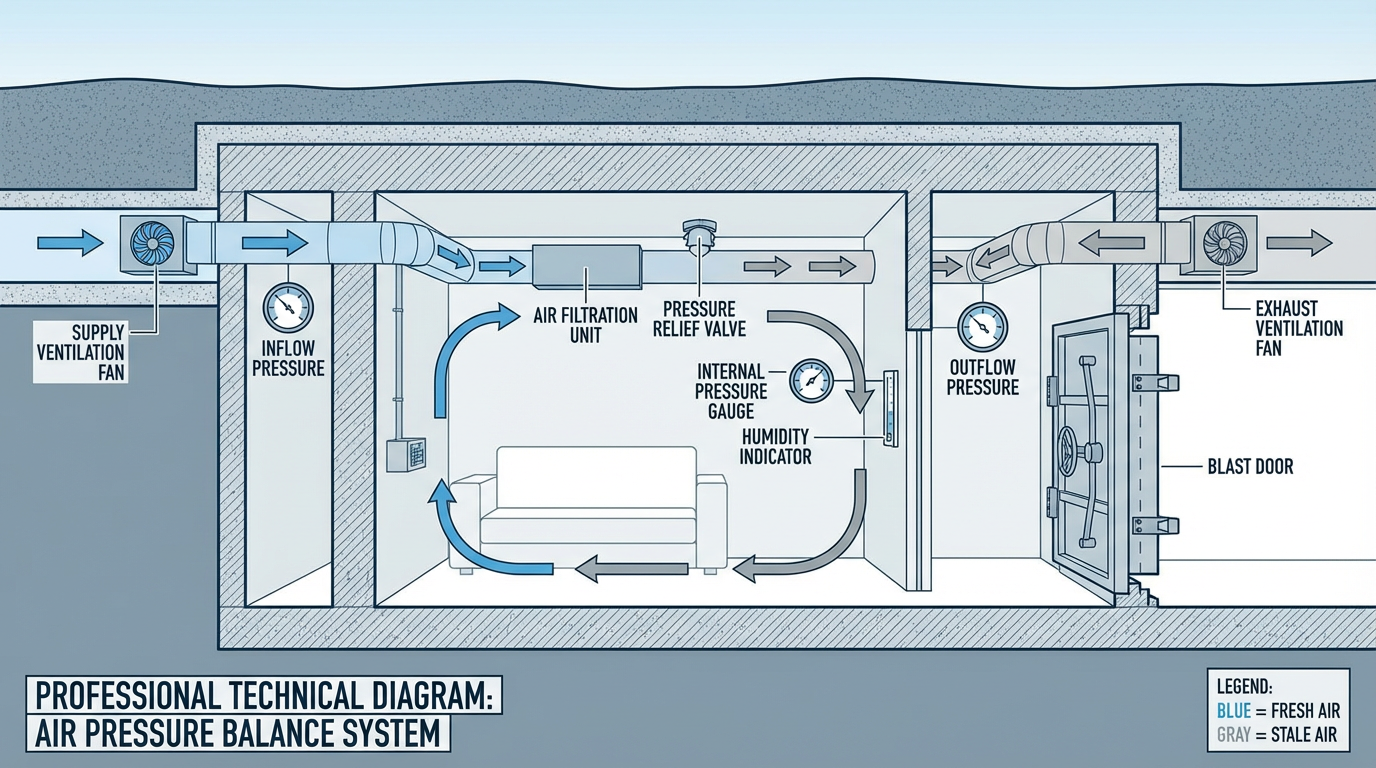
Underground bunkers are often described as "sealed environments." But truly sealed spaces introduce a complex engineering challenge that most people never consider: air pressure imbalance.
Without proper pressure control, a bunker can experience door failure, air infiltration, moisture intrusion, mechanical strain, and long-term structural stress. Air doesn't just need to circulate — it must be balanced.
In professionally engineered underground structures, pressure management is not an afterthought. It's a core design consideration integrated into ventilation systems, structural components, and even door selection.
Here's why air pressure balance matters — and how professional bunker engineers design for it.
Underground Structures Behave Differently Than Above-Ground Buildings
Above ground, buildings naturally equalize with exterior atmospheric pressure through minor leakage, window seals, door gaps, and building materials.
Underground, conditions change:
In a properly constructed bunker, the envelope is intentionally tight. That means pressure differences don't dissipate naturally. And when pressure isn't controlled, it accumulates.
What Causes Pressure Imbalance in a Bunker?
Several factors can shift internal pressure inside a sealed underground structure.
1. Mechanical Ventilation Systems
Supply fans push air in. Exhaust fans remove air.
- • If supply airflow exceeds exhaust airflow, the bunker becomes positively pressurized.
- • If exhaust exceeds supply, it becomes negatively pressurized.
Even small imbalances can create measurable pressure differences over time.
2. Temperature Differences
Warm air expands. Cool air contracts.
If interior air is heated while exterior soil temperatures remain lower, pressure gradients can form inside a tightly sealed envelope.
3. Barometric Pressure Changes
Missouri experiences significant barometric shifts during storm systems and seasonal transitions.
In an above-ground home, minor leakage allows structures to equalize gradually. In a sealed bunker, pressure changes outside can create differential loading on:
Professional designs account for these regional atmospheric variations.
Why Pressure Imbalance Is Dangerous
Many DIY or poorly engineered bunker designs ignore pressure control entirely. That can lead to serious problems.
1. Door Operational Failure
Bunker doors are heavy, gasketed, and often pressure-rated. If interior pressure builds beyond design tolerances, occupants may struggle to open or close entry doors.
- • Negative pressure can pull doors inward
- • Positive pressure can push outward against seals
- • In extreme cases, this stresses hinges and frames
2. Moisture Intrusion Through Micro-Gaps
Air carries moisture. When negative pressure exists inside a bunker, outside air is pulled inward through even microscopic imperfections in:
Over years, this slow infiltration can introduce condensation risks inside wall assemblies.
3. Mechanical System Strain
Fans operating against improper pressure loads:
- • Consume more energy
- • Wear out faster
- • Produce more noise
- • Lose efficiency
In sealed underground environments, mechanical systems must operate within controlled pressure ranges to maintain long-term reliability.
4. Structural Stress at Penetrations
While reinforced concrete walls handle soil pressure, penetrations represent localized vulnerability points. Pressure differentials can:
- • Stress vent sleeves
- • Distort thin-wall ducting
- • Compromise waterproof boots
- • Degrade gasket materials
Professional engineering ensures these areas remain within safe operating conditions.
The Difference Between "Airflow" and "Pressure Control"
Many people assume ventilation equals safety. But airflow alone is not enough.
A bunker could move air continuously while still developing harmful pressure imbalance.
True professional design separates two goals:
They are related — but not identical.
How Engineers Design for Pressure Balance
Pressure control is addressed through system sizing, redundancy, and calibrated design.
1Balanced Ventilation Systems
Professional bunker designs typically use:
Engineers calculate cubic feet per minute (CFM) requirements based on:
This ensures pressure neutrality during normal operation.
2Slight Positive Pressure Strategy (When Appropriate)
In some bunker designs — particularly EMP-protected or contamination-resistant models — engineers may design for slight positive pressure.
Why?
Positive pressure:
- Prevents unfiltered air from entering through micro-leaks
- Reduces inward moisture migration
- Enhances air quality control
But the key word is slight. Excessive positive pressure is equally problematic.
3Pressure Relief Pathways
Professional designs incorporate controlled relief mechanisms, such as:
These allow gradual equalization during rapid atmospheric changes — such as Missouri thunderstorm systems.
4Door and Seal Rating Integration
Entry doors are selected based on:
Door assemblies are integrated into the structural design — not treated as standalone components. This prevents operational failure under moderate pressure differentials.
Missouri-Specific Considerations
Springfield and surrounding counties experience:
These environmental factors influence underground pressure behavior. Professional bunker engineering accounts for:
- Seasonal atmospheric variability
- Soil temperature stability
- Humidity migration
- Long-term seal durability
This is why regional expertise matters. Pressure management strategies appropriate in arid climates may not perform the same way in Missouri.
Long-Term Livability Depends on Stability
Pressure imbalance doesn't usually cause immediate catastrophic failure. It causes slow degradation:
- Seal wear
- Mechanical inefficiency
- Condensation accumulation
- Hardware fatigue
Over decades, these small issues compound. True long-term underground infrastructure must maintain internal equilibrium — not just strength.
Pressure stability supports:
In generational bunker design, stability is everything.
Why DIY Designs Often Overlook This
Online bunker guides typically focus on:
- Wall thickness
- Concrete strength
- Waterproofing
- Filtration systems
Rarely do they discuss pressure equilibrium. Because it requires:
- Engineering calculations
- System integration
- Real-world performance modeling
- Understanding of long-term environmental behavior
Underground construction is a specialized discipline for this reason.
Engineering Philosophy: Control the Environment, Don't Fight It
Professional bunker design doesn't aim to create a perfectly sealed "box."
It aims to create a controlled system.
Air enters
in calculated ways
Air exits
in calculated ways
Pressure remains
stable
This balance allows the structure to function quietly and reliably for decades.
The Bottom Line
Air pressure is invisible — but its effects are not.
In sealed underground bunkers, unmanaged pressure imbalance can compromise:
Professional bunker construction integrates pressure balance from the earliest design stages.
Because true underground infrastructure isn't just about resisting soil and water. It's about engineering a stable internal environment that performs reliably — year after year.
Planning an Underground Bunker in Missouri?
At Bunker Up Buttercup™, we design and construct turnkey underground bunkers engineered for long-term structural integrity, moisture control, and environmental stability.
All structural plans are reviewed and stamped by licensed Missouri engineers. From excavation to final commissioning, we integrate mechanical balance, waterproofing, and structural performance into one cohesive system.
If you're considering a bunker in Springfield, Nixa, Ozark, Republic, or surrounding counties:
Call 417-895-8733Schedule a professional site consultation.
Because underground construction isn't just about strength. It's about control.
Bunker Up Buttercup™
Veteran-owned underground bunker construction company serving Springfield, MO and the surrounding 75-mile radius. Licensed general contractor specializing in doomsday bunkers, storm shelters, and survival infrastructure engineered for Missouri's unique soil and weather conditions.
Request a Consultation